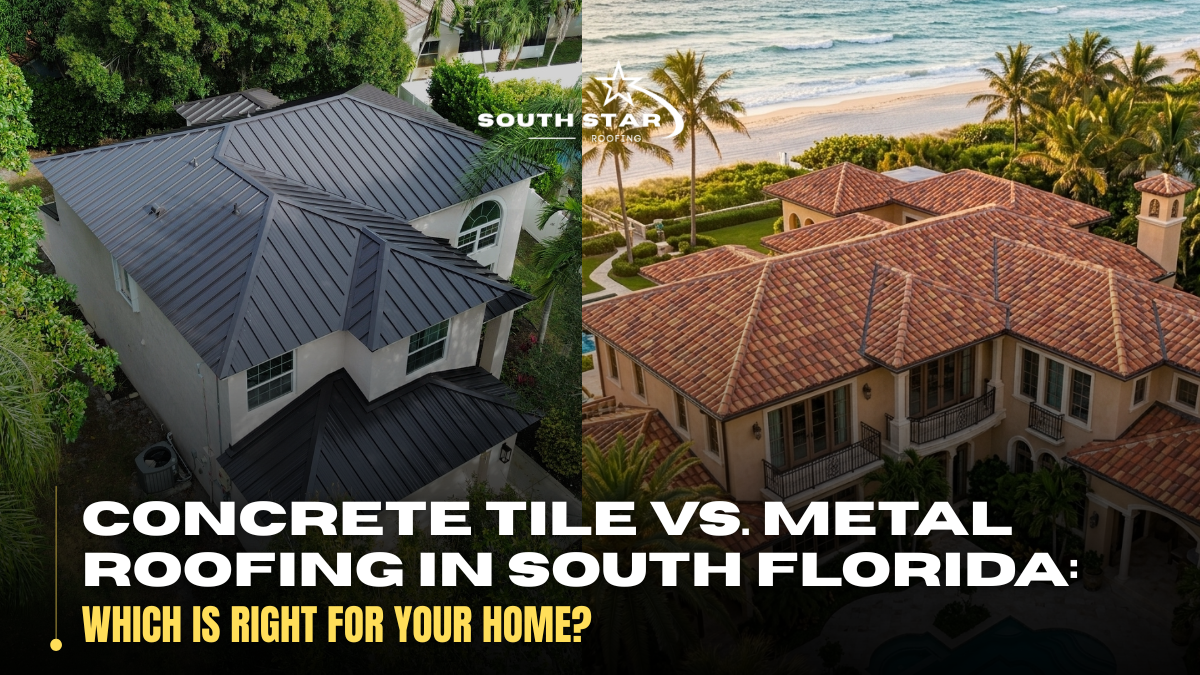
Concrete Tile vs. Metal Roofing in South Florida: Which Is Right for Your Home?
If you are a homeowner in Palm Beach County or Broward County, choosing between concrete tile and metal roofing is one of the biggest decisions you will make. Both materials are excellent choices for South Florida’s harsh climate — but they serve different needs, budgets, and aesthetics. At South Star Roofing, we install both, and we want to give you an honest, local perspective so you can choose with confidence.
Why Your Roof Material Matters More in South Florida
South Florida is not a forgiving environment for roofs. With hurricane-force winds, intense UV radiation, salt air near the coast, and heavy rain from June through November, your roof faces more stress than almost anywhere else in the country. Choosing the right material is not just about curb appeal — it directly impacts your insurance premiums, home value, and long-term cost of ownership.
Concrete Tile Roofing: The South Florida Classic
Concrete tile roofing has dominated South Florida neighborhoods for decades, and for good reason. The Mediterranean and Spanish Colonial architectural styles that define communities from Boca Raton to Wellington are practically synonymous with barrel tile roofs.
Advantages of Concrete Tile in Palm Beach and Broward
- Exceptional longevity — concrete tile roofs routinely last 20 to 25 years when properly maintained
- Natural thermal mass keeps attic temperatures lower, which can reduce cooling costs
- Excellent wind resistance — most profiles are rated to withstand 150 mph winds when installed correctly
- Aesthetic variety — available in flat, low-profile, and barrel profiles in dozens of colors
- Strong resale value — buyers in Palm Beach County recognize and expect tile on higher-end homes
Disadvantages of Concrete Tile
- Heavier than metal — older homes may require structural reinforcement
- Higher upfront installation cost compared to shingle, though comparable to standing seam metal
- Individual tiles can crack from foot traffic or falling debris and require periodic replacement
- The underlayment beneath the tile typically needs replacement every 20 to 25 years, even if the tile itself is intact
Metal Roofing: The Modern, Storm-Ready Choice
Metal roofing has surged in popularity across South Florida over the past decade, and it is easy to understand why. Modern metal roofs look nothing like the corrugated barns of the past. Standing seam metal roofing, in particular, offers a sleek, contemporary aesthetic that complements new construction and modern home designs.
Advantages of Metal Roofing in South Florida
- Outstanding wind resistance — standing seam systems can be rated to 160 mph or higher
- Lighter weight than tile — no structural concerns for most homes
- Exceptional lifespan — a quality metal roof can last 50 years or more
- Highly reflective — cool-metal roofing products can meaningfully reduce cooling loads
- Minimal maintenance — no individual panels to crack or replace
- Insurance-friendly — many Florida insurers look favorably on metal roofing for wind mitigation credits
Disadvantages of Metal Roofing
- Higher upfront cost than asphalt shingles and often comparable to or higher than tile
- Can be noisier during heavy rain — though proper insulation mitigates this significantly.
- Expansion and contraction in South Florida’s heat must be accounted for in the installation
- Fewer traditional aesthetic options — less common on Mediterranean-style homes
“Both tile and metal can earn you wind mitigation credits in Florida — but the installation method and fastening system matter as much as the material itself.”
Cost Comparison: What to Expect in Palm Beach and Broward County
Pricing varies based on roof size, pitch, complexity, and specific product choices, but here is a general range for South Florida residential projects:
- Concrete tile replacement: typically $20,000 to $35,000 for an average single-family home.
- Standing seam metal replacement: typically $40,000 to $60,000 depending on the profile and gauge.
- Exposed fastener metal panel systems are available at lower price points but offer less wind protection
Remember that the cost of your roof should always be evaluated over its full lifespan. A tile roof that lasts 25 years or a metal roof that lasts +50 years costs far less per year than a shingle roof replaced every 20 years.
Insurance Implications: A Critical Factor for Florida Homeowners
Florida’s homeowners insurance market is notoriously difficult. Your roof material and age directly affect whether you can get coverage and how much you will pay. Both concrete tile and metal roofs are viewed positively by most Florida insurers compared to asphalt shingles. A certified wind mitigation inspection after your new roof is installed can document your roof’s storm resistance and potentially save you hundreds of dollars annually on your premium.
Which Roof Is Right for Your Home?
The honest answer is: it depends on your home, your neighborhood, and your goals. If you live in a traditional Mediterranean-style community in Wellington, Boca Raton, or Delray Beach and want a long-lived roof that fits the neighborhood aesthetic, concrete tile is almost certainly your best choice. If you have a newer, modern home or a home that needs a lighter-weight system, standing seam metal is a premium option worth the investment.
The most important step is getting a professional assessment from a licensed roofing contractor who knows Palm Beach and Broward County codes, HOA requirements, and insurance dynamics. That is exactly what South Star Roofing provides — no pressure, just expert guidance. Call us at (561) 537-5544 or [email protected]